
Coolant Distribution Units (CDU)
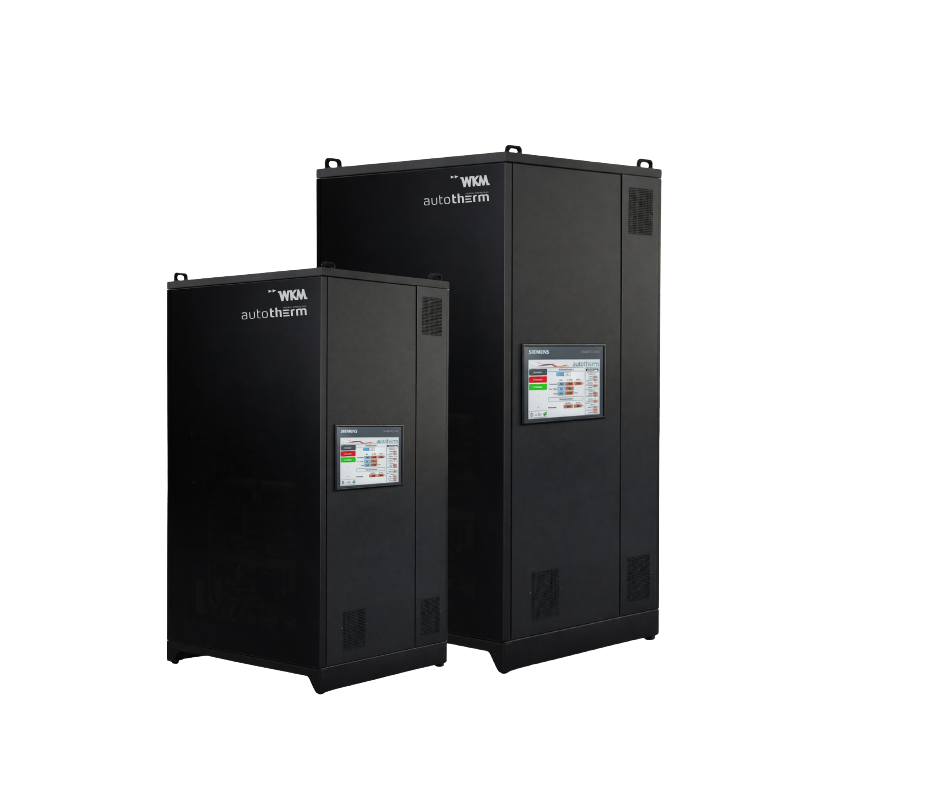
Modern data centers are hitting a physical limit: the denser AI, GPU and HPC systems are packed, the more heat builds up in a small space – more than air can reasonably carry away. The Coolant Distribution Unit (CDU) is the component that solves exactly this problem. It brings liquid cooling safely to the servers and connects it, in a controlled way, to the building’s cooling system.
At autotherm, these systems are based on a proven product platform that we size precisely to your application – built on decades of experience in industrial temperature-control engineering and manufactured at a single site in Germany.
Why modern servers need active cooling
Almost all of the electrical power a server draws is converted into heat. The highest loads occur where the computing happens: at the CPU, GPU and power electronics. As power density rises, local heat-flux densities become critical.
If that heat is not removed, the hardware protects itself – it throttles performance (thermal throttling) or, in the worst case, shuts down. Sustained high temperatures shorten component life and increase the risk of failure. Put simply: without reliable heat removal there is no stable compute performance.
What a CDU does
The CDU is the interface between the building’s cooling system (facility side) and the IT liquid cooling (secondary side). Think of it as a translator between two worlds: it keeps facility systems and server cooling working together reliably, even though the two circuits have very different requirements.
At its core, it handles five tasks:
- Heat transfer between the primary and secondary circuits
- Pumping and flow-rate control
- Pressure and differential-pressure control
- Temperature control
- Monitoring and protective functions
A key benefit is hydraulic decoupling: the primary and secondary circuits are fully separated. Pressure fluctuations, different media or control actions on the facility side therefore do not carry over into the sensitive IT circuit.
Why liquid cooling – and why now
With AI, GPU clusters and HPC, power densities are rising so steeply that purely air-based concepts reach their physical limits. The reason lies in the physics of the medium: per cubic meter, water carries roughly 3,500 times more heat than air. Liquid removes the heat where it is generated – directly at the chip – and does so far more efficiently.
This is why direct liquid cooling is becoming the standard for the economical and safe operation of high-density racks. The CDU creates the prerequisite for it: a stable, controlled IT cooling circuit, independent of fluctuations in the building’s water network.
The thermal path in direct liquid cooling
From the chip to final heat rejection, the heat passes through several stages:
1

Cold plate on the processor
– absorbs the heat directly at the source.
2

Secondary circuit
– transports it to the CDU.
3

CDU
– transfers the heat, under control, to the facility circuit and decouples the two systems.
4

Facility Cooling
– carries the heat away to energy-efficient heat rejection.
What matters is how the whole chain works together: from the temperature level at the chip to the building’s cooling, everything has to be matched. This translation task is exactly where the CDU comes in.
Not just capacity – the right solution
A cooling figure in kW is a starting point, not a finished solution. Whether a CDU really fits depends on your application – on the temperatures, flow rates, pressures and media on the primary and secondary sides. So we don’t start with a number; we start with your use case.
- Assess the application: we analyze your operating conditions instead of just assuming a kW figure.
- Draw on the platform: we select the right size from our proven, field-tested product platform.
- Modify where needed: if your case goes beyond the standard, we adapt in a targeted way – for a perfect fit.
Proven technology as the basis, your application as the benchmark – the result is a CDU that runs reliably and still fits exactly.
Availability and redundancy to DIN EN 50600
Data centers are planned according to availability classes – from VK 1 (basic infrastructure) through VK 2 and VK 3 to VK 4 (very high availability, multi-path infrastructure). For the CDU, a higher availability class means, for example:
- Redundancy of pumps and other components
- Separate supply paths
- Maintenance during ongoing operation
This keeps cooling available even during service work or faults – a critical factor precisely for AI and HPC applications, where downtime is expensive.

Integration into the data center infrastructure
A CDU does not stand alone; it fits into your existing control and monitoring technology. autotherm CDUs integrate with building management systems (BMS), monitoring systems, DCIM platforms and energy-optimization concepts.
Open interfaces are available for communication, including Modbus TCP/IP, OPC UA, SNMP and BACnet. Setpoints, actual values, operating states and fault messages are passed transparently to the higher-level systems.
Our design philosophy
We do not design our CDUs for maximum feature count, but for controllable operation. Four principles guide the engineering:
- Stability – the secondary circuit stays within a defined operating window, even under dynamic load changes.
- Precision – key operating variables are not just monitored but actively controlled.
- Predictability – the control behavior is reproducible under identical conditions.
- Transparency – relevant operating states are visible and assessable at all times.
The result is an IT cooling circuit that runs stably, is precisely controlled, predictable and traceable.
Why autotherm
Our Coolant Distribution Units are built on the same technological foundation as our conditioning systems, proven over decades: precise control of temperature, flow rate and pressure – with demanding requirements for dynamics and stability. The CDU platform brings this proven technology base to the data center.
As a systems manufacturer with high vertical integration, we develop and build at our site in Germany. For you this means two things: a standardized, reproducible series – and the ability to adapt for special requirements when needed, without changing suppliers.
autotherm – Made in Germany.
Your next step
Planning liquid cooling for your data center? Talk to us – we assess your application, select the right size from our platform and modify it where it makes sense.
CDU Inquiry – Performance Data
Coolant Distribution Unit (CDU) for Direct Liquid Cooling (DLC)
